
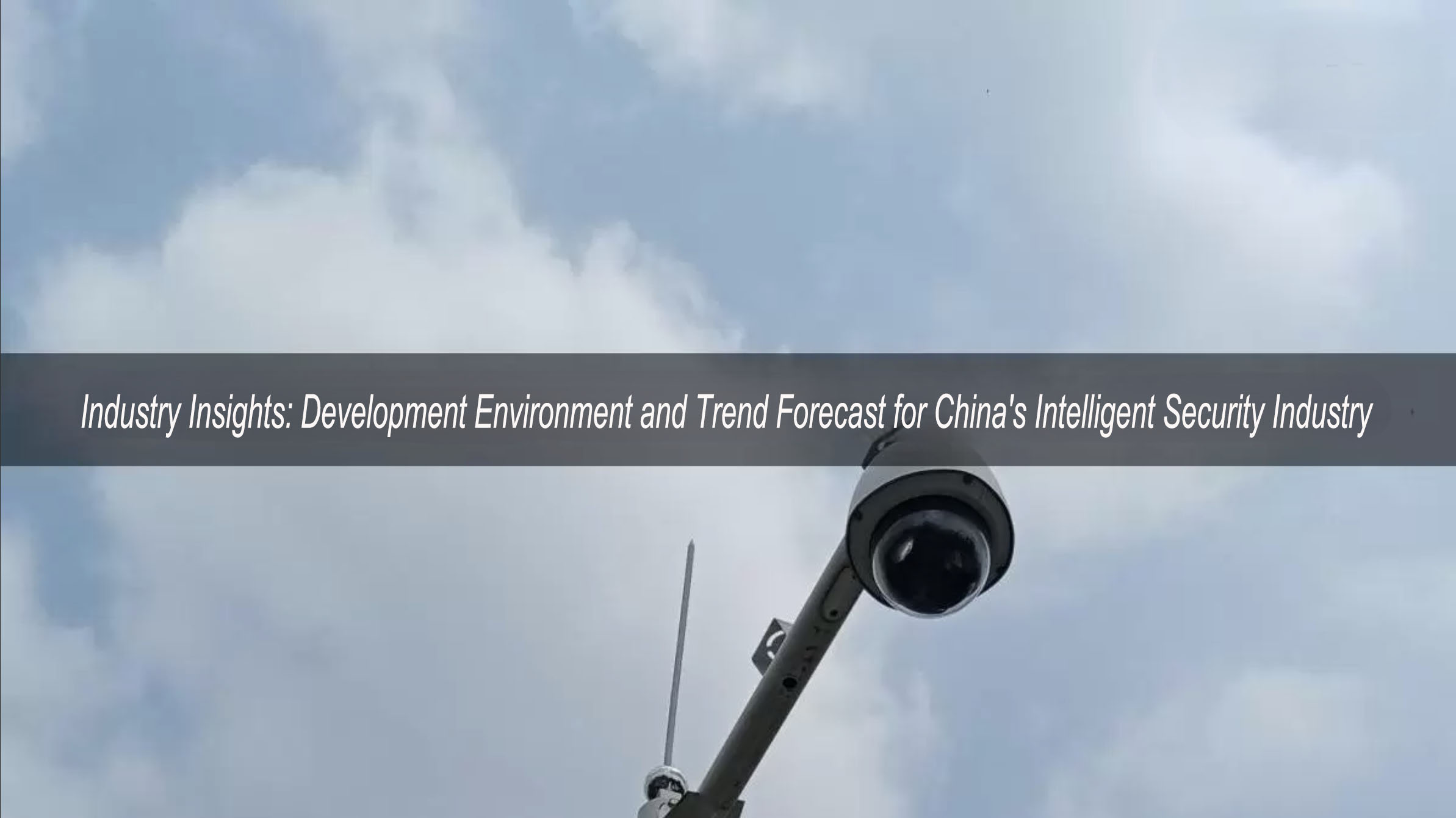
Smart security is driving the traditional security industry from digitalization and networking toward intelligence, supported by the Internet, big data, artificial intelligence, and growing market demand.
Based on the traditional security industry, smart security integrates multiple technologies, including the Internet, big data, and artificial intelligence.
These technologies are driving the security industry from digitalization and networking toward intelligence.
Today, smart security has become an emerging industry with a market scale of hundreds of billions.
This article discusses several key aspects of China’s smart security industry development environment and provides a forecast of the industry’s future direction.
1. Development Environment of China’s Smart Security Industry
1.1 Policy Environment
With the continuous development of the Internet of Things, artificial intelligence, and related industries, the intelligence level of the security industry has been improved to a certain extent.
After years of development, smart security has gradually become a large-scale industry.
In recent years, various national departments in China have issued policies to support the development of the smart security industry.
For example, in July 2022, the Ministry of Housing and Urban-Rural Development and the National Development and Reform Commission jointly issued and implemented the 14th Five-Year Plan for National Urban Infrastructure Construction.
The plan clearly proposed accelerating the construction of smart communities.
It encouraged communities to build supporting facilities such as:
- Intelligent parking
- Smart parcel lockers
- Smart charging piles
- Smart lamp poles
- Smart trash bins
- Smart security systems
- These facilities are expected to improve the level of intelligent services in communities.
1.2 Economic Environment
At present, China’s economy is gradually entering a stage of rapid development.
The gross domestic product has continued to rise.
In 2022, China’s national GDP exceeded 121 trillion yuan, representing a year-on-year growth of 3.0%.
In the same year, the per capita disposable income of residents reached 36,900 yuan, with a nominal year-on-year increase of 5.0%.
With the continuous improvement of residents’ consumption levels, various consumer markets are gaining new development momentum.
Emerging markets represented by smart security products are expected to become gradually accepted by the public, thereby promoting the rapid development of the industry.
1.3 Social Factors
Over the years, the number of public security cases accepted by domestic public security authorities has continued to decline.
However, from an overall perspective, the number remains at a relatively high level.
At the current stage, there are still certain hidden risks in social security.
Residents’ investment in personal and property safety is also increasing accordingly.
By using smart security products, individuals and organizations can better protect their own safety.
This is further driving the growth of market demand.
2. Future Trends of China’s Smart Security Industry
2.1 Wider Adoption Across Different Application Scenarios
According to research data, cities are currently the main application scenario for smart security in China.
The market share of urban applications exceeds 50%.
Compared with other fields, the penetration rate in non-urban scenarios is still relatively low.
As China’s economic development continues to accelerate, demand for smart security products in different fields is expected to increase rapidly.
By using smart security products, users can achieve functions such as:
- Video monitoring
- Security management
- System maintenance
- Intelligent alerts
- Safety protection
- These functions can improve overall security protection.
- Therefore, it is expected that China’s smart security products will become widely adopted across more application scenarios in the future.
2.2 Intensified Market Competition
At the enterprise level, there are many companies in China’s security industry.
At the same time, the number of newly established companies is also increasing with fluctuations.
After long-term industry development, some small and medium-sized enterprises lacking market competitiveness have gradually been eliminated.
Industry resources are increasingly concentrating toward leading companies.
This trend promotes the coordinated development of the entire industrial chain among leading enterprises.