
Power over Ethernet (PoE) is a technology that allows both data and electrical power to be transmitted over a single Ethernet cable to power connected devices. Traditionally, network devices such as IP cameras, wireless access points, and IP phones required separate power supplies, which could complicate wiring, increase costs, and create reliance on power outlets. PoE technology addresses these challenges, offering greater flexibility and convenience for the deployment of network devices.
History and Development of PoE
PoE technology was first proposed by Cisco Systems and standardized by IEEE in 2003 under the IEEE 802.3af standard. As network devices became more prevalent, PoE technology was further developed. Later, IEEE introduced an updated PoE standard, IEEE 802.3at, also known as PoE+, to support devices requiring higher power.
Functions and Advantages of PoE
- Simplified Cabling: PoE allows data and power to be transmitted over a single Ethernet cable, eliminating the need for additional power lines. This simplifies the cabling process and reduces costs and complexity.
- Increased Flexibility: PoE enables devices to be deployed more flexibly in various locations without being restricted by the availability of power outlets. It is particularly useful for temporary or mobile deployments.
- Reduced Energy Consumption: Traditionally, many network devices need to remain powered even when not in use. PoE allows for more flexible power control, reducing energy consumption.
- Improved Reliability: PoE provides a stable and reliable power supply, which reduces the risk of network interruptions caused by power failures.
How PoE Works
In traditional Ethernet setups, devices usually require two separate connections: one for data transmission and another for power supply. This means that in addition to data cables, each device needs a separate power line, increasing cabling complexity and requiring more power outlets.
PoE works by transmitting DC power over the Ethernet cable to power the connected device. This involves two main components: Powered Devices (PD) and Power Sourcing Equipment (PSE).
- Powered Device (PD): A PD is a device that receives power through the Ethernet cable, such as an IP camera, IP phone, or wireless access point. PD devices typically include a PoE interface for receiving power from the PSE.
- Power Sourcing Equipment (PSE): A PSE is a device that provides power, such as a switch or injector. The PSE sends current through the Ethernet cable to supply the PD.
PoE uses the unused pairs in the Ethernet cable (typically the data pairs) to transmit power. Before power transmission begins, the PSE sends a special signal, known as “detection” or “classification,” to identify whether the connected device supports PoE and determine the required power level. Once the device is confirmed to support PoE and the required power is available, the PSE transmits power over the data pairs while keeping the data transmission capability intact.
Components of PoE
- PoE Power Sourcing Equipment (PSE): These are devices responsible for supplying power to network devices, typically network switches or dedicated PoE injectors.
- PoE Devices (PD): These are devices that receive power from the PSE, such as IP cameras, IP phones, or wireless access points.
- PoE Middleware: This refers to software or hardware components used to manage and monitor PoE networks, including power management and consumption monitoring.
Applications of PoE
- Enterprise Networks: PoE is widely used in enterprise networks to power devices like IP phones, wireless access points, and network cameras. It allows for simpler, more flexible network deployment and reduces management and maintenance costs.
- Home Networks: PoE can be used to connect smart home devices, such as smart cameras and smart speakers, enabling easier deployment and management without worrying about power outlet availability.
- Public Spaces: In public spaces such as airports, shopping malls, and hotels, PoE can be used to deploy security systems and wireless networks, providing users with safer and more convenient services.
PoE Standards
IEEE 802.3af Standard
IEEE 802.3af is a network standard commonly referred to as PoE (Power over Ethernet), allowing Ethernet cables to provide power to network devices. This standard was officially released in 2003, marking the beginning of a new era in network design.
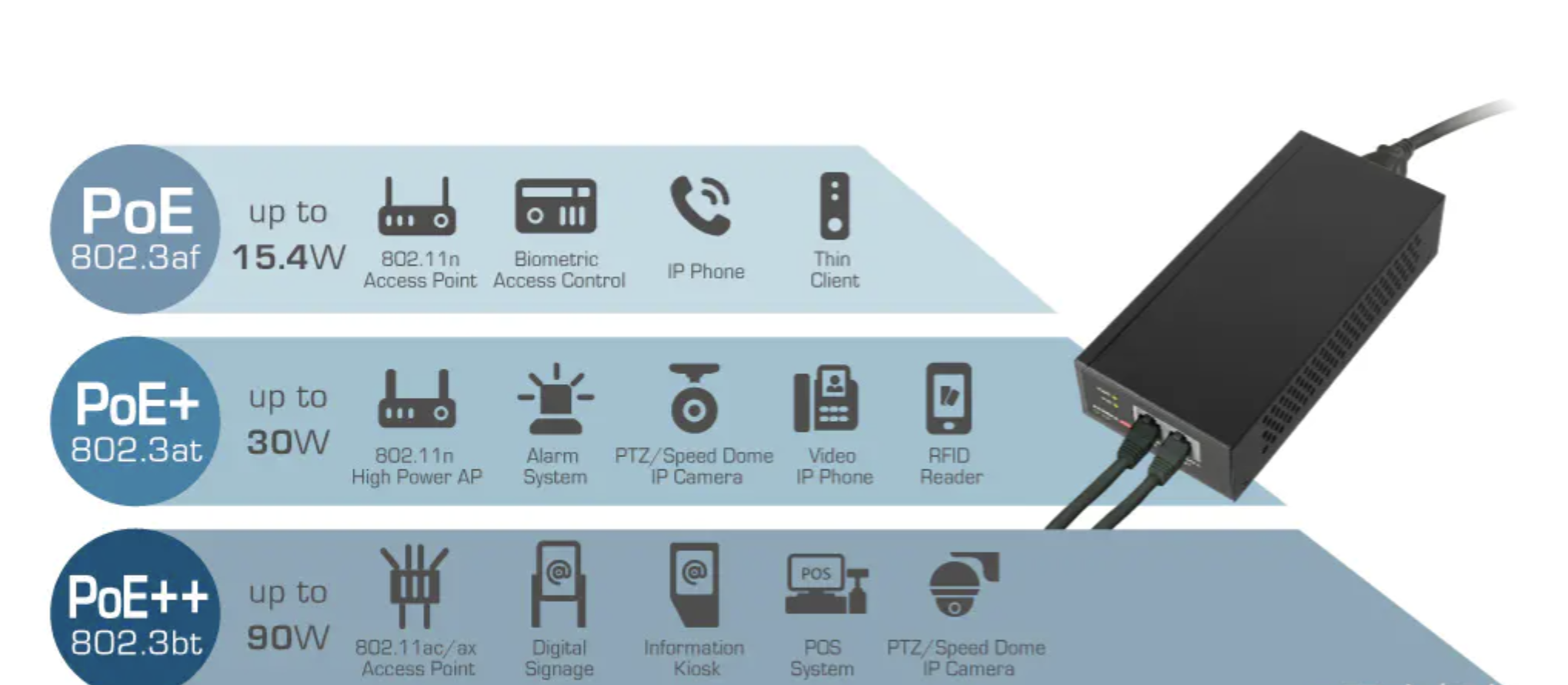
The IEEE 802.3af standard laid the foundation for delivering power over Ethernet cables to various devices, including IP cameras, VoIP phones, and WLAN access points. It provides a maximum of 15.4 watts of power per port, but due to power loss over the cables, the actual available power is approximately 12.95 watts.
The introduction of this standard made network deployment more flexible and convenient by eliminating the need for separate power lines, thus reducing costs and complexity. PoE also brought higher reliability and energy efficiency by reducing reliance on power outlets and lowering energy consumption.
IEEE 802.3at Standard
IEEE 802.3at, also known as PoE+ (Power over Ethernet Plus), is an enhancement and expansion of the IEEE 802.3af standard. Released in 2009, it provides a higher power output solution to meet the needs of more power-hungry network devices.
The IEEE 802.3at standard expands the PoE power output capacity, allowing each port to provide up to 30 watts of power. This is double the maximum output of the 802.3af standard, which can only provide up to 15.4 watts. The IEEE 802.3at standard supports more types of devices, including dual-band wireless access points, PTZ (pan-tilt-zoom) cameras, and VoIP video phones.
In addition to providing higher power output, the 802.3at standard introduces new features like power management and classification to improve power transmission efficiency and reliability. These features allow PoE+ devices to manage power delivery intelligently, dynamically adjusting power output for better energy efficiency and paving the way for future network infrastructure development.
IEEE 802.3af vs IEEE 802.3at
- Power Output Capacity:
- IEEE 802.3af:
- Maximum power output: 15.4 watts per port.
- Available power: approximately 12.95 watts due to power loss.
- IEEE 802.3at (PoE+):
- Maximum power output: 30 watts per port.
- Available power: at least 25.5 watts per port.
- IEEE 802.3af:
- Supported Devices:
- IEEE 802.3af:
- Suitable for low-power devices such as IP cameras, VoIP phones, wireless access points, etc.
- Not suitable for high-power devices.
- IEEE 802.3at:
- Designed for higher-power devices.
- Supports more types of devices, including dual-band wireless access points, PTZ cameras, VoIP video phones, etc.
- IEEE 802.3af:
Introduction to Other PoE Standards In addition to IEEE 802.3af and IEEE 802.3at, there are other PoE standards such as IEEE 802.3bt, also known as PoE++ or 4PPoE (Four-Pair PoE). This new standard provides even higher power output, up to 60 watts or more, to meet the increasing power demands of network devices. IEEE 802.3bt also introduces new features like two different power modes (Type 3 and Type 4) and supports new types of high-power devices.