
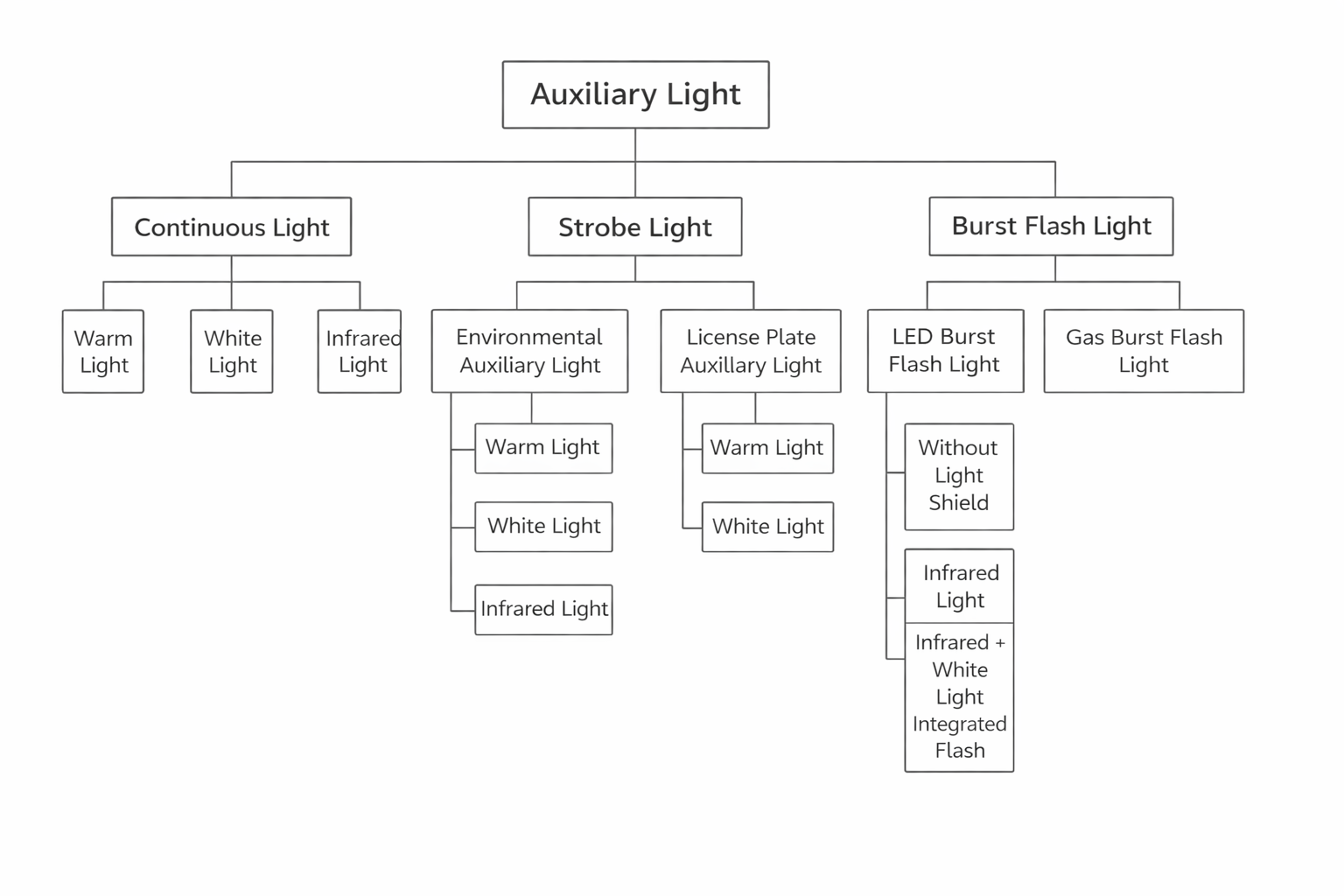
- Intelligent transportation auxiliary lights are generally divided into three main categories: burst flash lights, strobe lights, and continuous lights.
- Function implementation:
To provide professional auxiliary lighting for video surveillance, and for the detection and capture of vehicles, pedestrians, and other targets. - The auxiliary lights can be roughly classified as follows. In actual project applications, suitable auxiliary lights can be selected according to project requirements by contacting sales personnel.
Continuous Light
Used for environmental brightness compensation at monitoring points to improve overall video brightness.
Effective illumination distance: 16–25 meters.
- Supports photosensitive switch control and automatically turns on under low illumination conditions.
Some models support brightness adjustment through short-circuit control wires, RS-485, or network control. - According to the illumination range, single-lane and three-lane auxiliary light models are available.
- When used with CMOS sensor cameras, continuous lights can effectively prevent bright and dark stripes in video and improve video surveillance quality.
- Mainly used for smart surveillance / micro checkpoints and video monitoring scenarios for environmental illumination.
Continuous Light Installation Instructions
- The installation position of the continuous light should be more than 3 meters away from the capture camera to avoid reflected light affecting license plate recognition.
There should be no obstructions such as billboards or tree branches in front of the illumination path. - Continuous lights use photosensitive switch control and automatically turn on or off according to ambient illumination.
Generally, linkage control with the capture camera is not required; only the power cable of the continuous light needs to be connected. - Some continuous lights are equipped with control wires (on/off and brightness control), which can be connected to the camera’s F port or RS-485 port.
The auxiliary light on/off and brightness can be adjusted through camera parameter configuration.
The specific wiring and adjustment methods depend on the auxiliary light model.
Strobe Light
Used for lane environment and license plate illumination.
Unlike continuous lights, the LEDs flash at a certain frequency and duty cycle rather than remaining constantly on.
When the frequency is low, visible flickering can be observed.
Effective illumination distance: 16–25 meters.
- Strobe lights do not support photosensitive switch control.
Power on/off, brightness adjustment, and flashing frequency are all controlled by the camera and can be flexibly adjusted based on video and capture results in the project. - According to the illumination angle, strobe lights are divided into:
- Single-lane environment illumination lights (illumination angle: 15°)
- Three-lane license plate illumination lights (illumination angle: 45°)
- Strobe lights cannot be used with CMOS capture cameras, as bright and dark stripes will inevitably appear in the video.
- Mainly used in video electronic police and video checkpoint systems.
Strobe Light Installation Instructions
- For integrated capture cameras with built-in license plate strobe lights, only parameter configuration is required.
For external license plate strobe lights, the installation distance from the capture camera should be ≤ 1 meter, covering three lanes. - Environmental illumination strobe lights should be installed 3–4 meters away from the capture camera and cover one lane.
For three lanes, two strobe lights can be used to cover all lanes. - Strobe lights have two sets of cables:
- The power cable supplies power to the light
- The control cable connects to the camera’s F port and is responsible for turning the light on and off
- When the number of F ports on the capture camera is insufficient, strobe lights with the same function on the same camera can share one F port.
Burst Flash Light
Includes gas burst flash lights and LED burst flash lights, which are used to provide instantaneous illumination for capture targets with very high brightness.
- Gas burst flash lights can meet project requirements for clearly capturing the facial features of drivers and passengers throughout the entire day.
- The burst flash light is connected to the camera and provides instantaneous illumination when a vehicle is captured.
- When ambient illumination is low, burst flash lights need to be used in combination with environmental auxiliary lights or license plate lights.
- Mainly used in checkpoint systems, including video checkpoints, loop detector checkpoints, and radar checkpoints.
Burst Flash Light Installation Instructions
- In checkpoint systems requiring facial recognition, one burst flash light per lane is configured to illuminate passing vehicles and capture clear facial features of drivers and passengers.
- The installation distance between the burst flash light and the capture camera is 5 meters.
When one capture camera manages multiple lanes, the auxiliary lights can be installed on both sides or on the same side of the camera, depending on the length of the pole cross-arm. - In the latest eco-friendly checkpoints and ecological checkpoints, integrated two-in-one or three-in-one auxiliary lights are installed 3–4 meters away from the capture camera.
- The control cable must be connected to the camera’s F port.
Burst flash lights for different lanes must be connected to different F ports on the capture camera and cannot share the same interface.